
A music scale is a set of notes, ordered by pitch, that gives a song its home base and its mood. This guide shows how scales are built from whole and half steps. It covers nine scales with examples, and explains how to use them in a piano roll to write melodies and chords that fit together.
What is a music scale?
A scale is a collection of notes arranged from low to high, usually within one octave. The first note is the tonic. It is the note the music wants to return to, and it names the scale. C major starts on C. A minor starts on A.
The tonic alone does not define a scale. The pattern of gaps between the notes does. That pattern explains why C major sounds bright and A minor sounds darker, even though they share the same seven notes. We cover how that works further down.
For producers, a scale is a practical filter. It tells us which of the 12 available notes will sound “right” in a track. It also tells us which notes add tension.
What you need before you start
You don’t need to read sheet music. Here is what helps:
- A keyboard you can see. A MIDI controller, a cheap keyboard, or the piano roll in any DAW works.
- A free DAW or notation app. LMMS is free, open source (GPL) and runs on Windows, macOS and Linux. MuseScore Studio is also free and open source, and it shows notes on a staff if you want to learn notation as well.
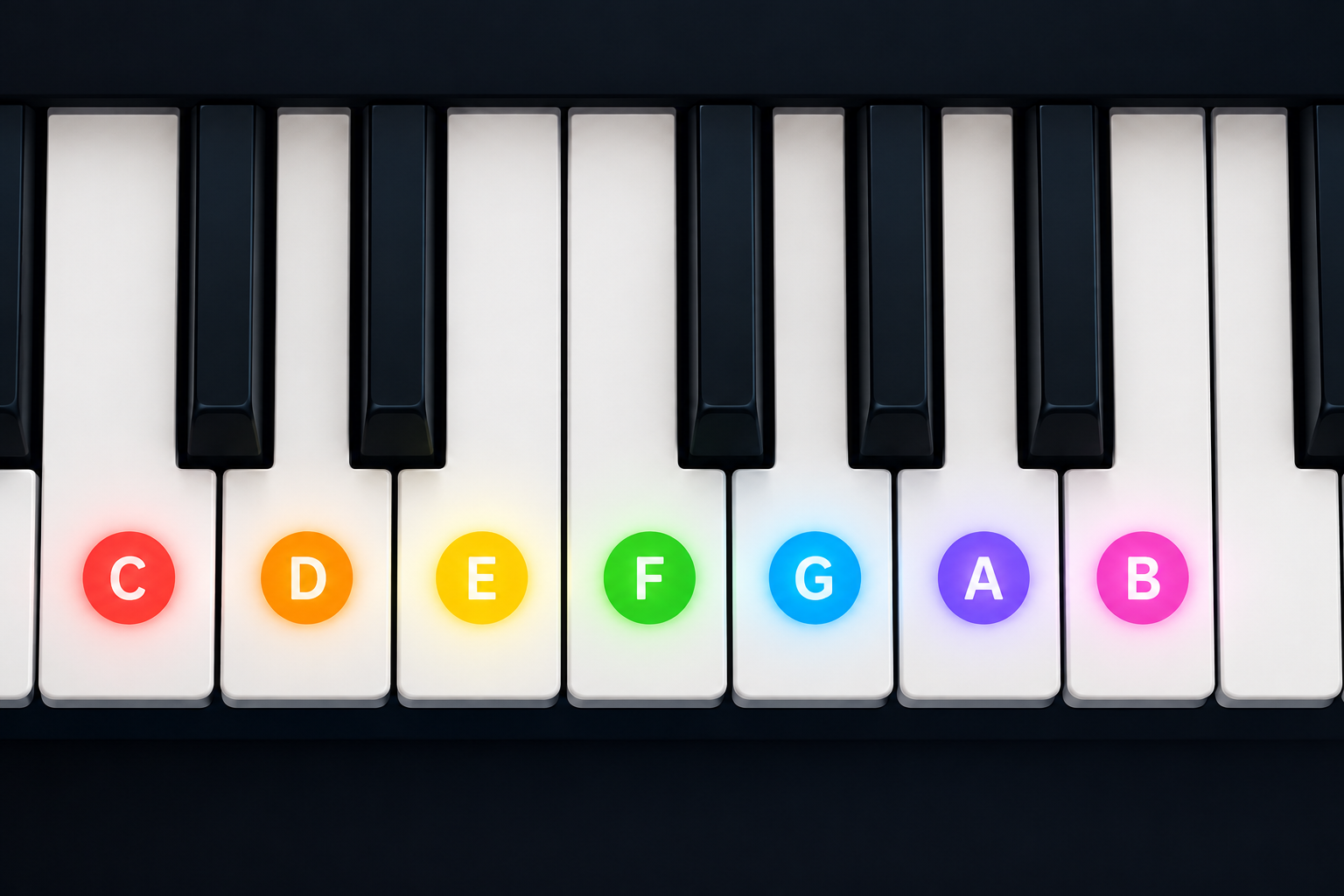
- Basic note names. These are the letters A to G, plus sharps (♯) and flats (♭).
- About 20 minutes to build your first two scales by hand.
The building blocks: 12 notes, half steps and whole steps
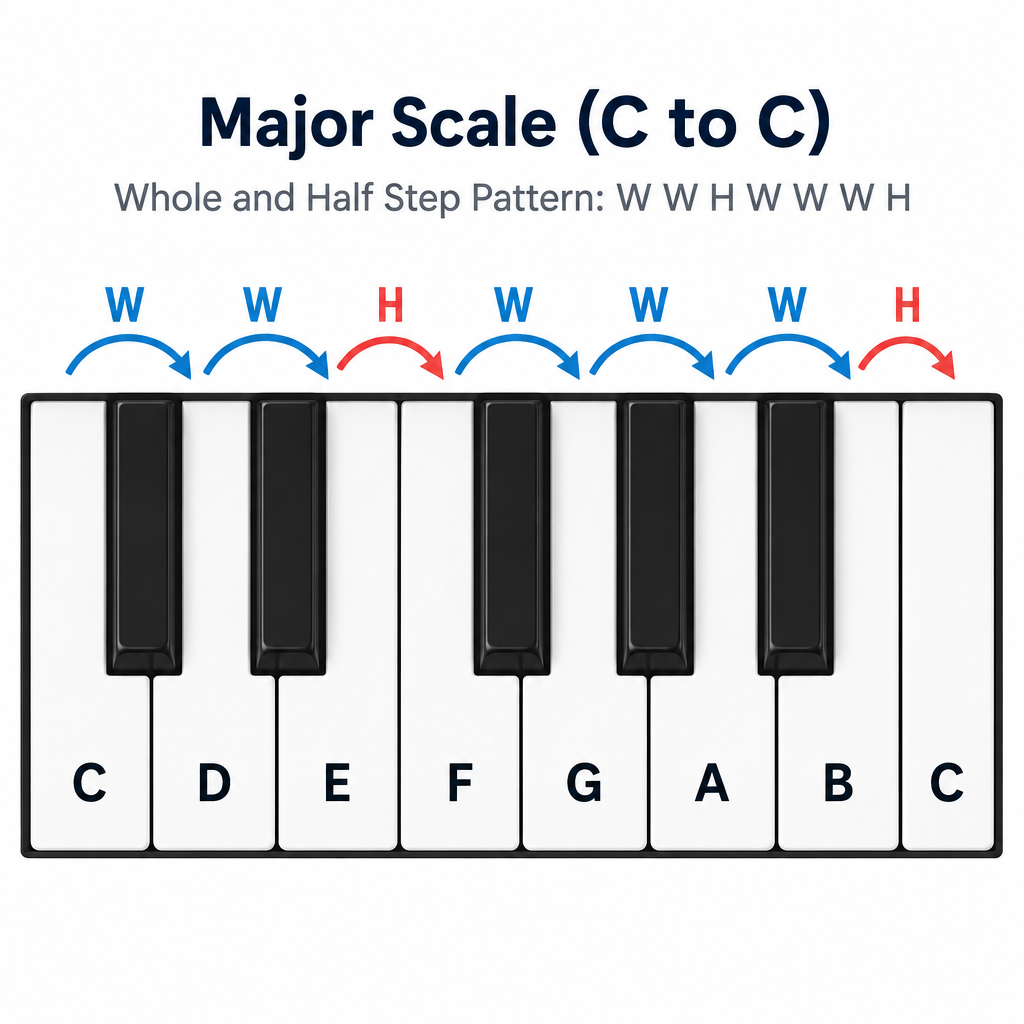
Western music uses 12 different notes per octave. After B, the cycle starts again at C, one octave higher.
| # | Note | # | Note |
|---|---|---|---|
| 1 | C | 7 | F♯ / G♭ |
| 2 | C♯ / D♭ | 8 | G |
| 3 | D | 9 | G♯ / A♭ |
| 4 | D♯ / E♭ | 10 | A |
| 5 | E | 11 | A♯ / B♭ |
| 6 | F | 12 | B |
Notes with two names, like C♯ and D♭, are the same key on a piano. These are called enharmonic notes.
Two distances matter:
- Half step (H): one semitone. This is the move to the very next key, black or white. C to C♯ is a half step.
- Whole step (W): two semitones. C to D is a whole step, because C♯ sits between them.
On a piano, every white key has a black key between it and its neighbour except at two places. E to F and B to C are half steps with no black key in between. Most beginner mistakes come from forgetting those two spots.
Producer tip
Piano rolls count in semitones, so learn scales as numbers. Major is 0, 2, 4, 5, 7, 9, 11. Natural minor is 0, 2, 3, 5, 7, 8, 10. Count up from any root note and you can program a scale in any key without naming a single note.
The formula behind scales
Every scale is a fixed recipe of whole and half steps. Here are the two we use most.
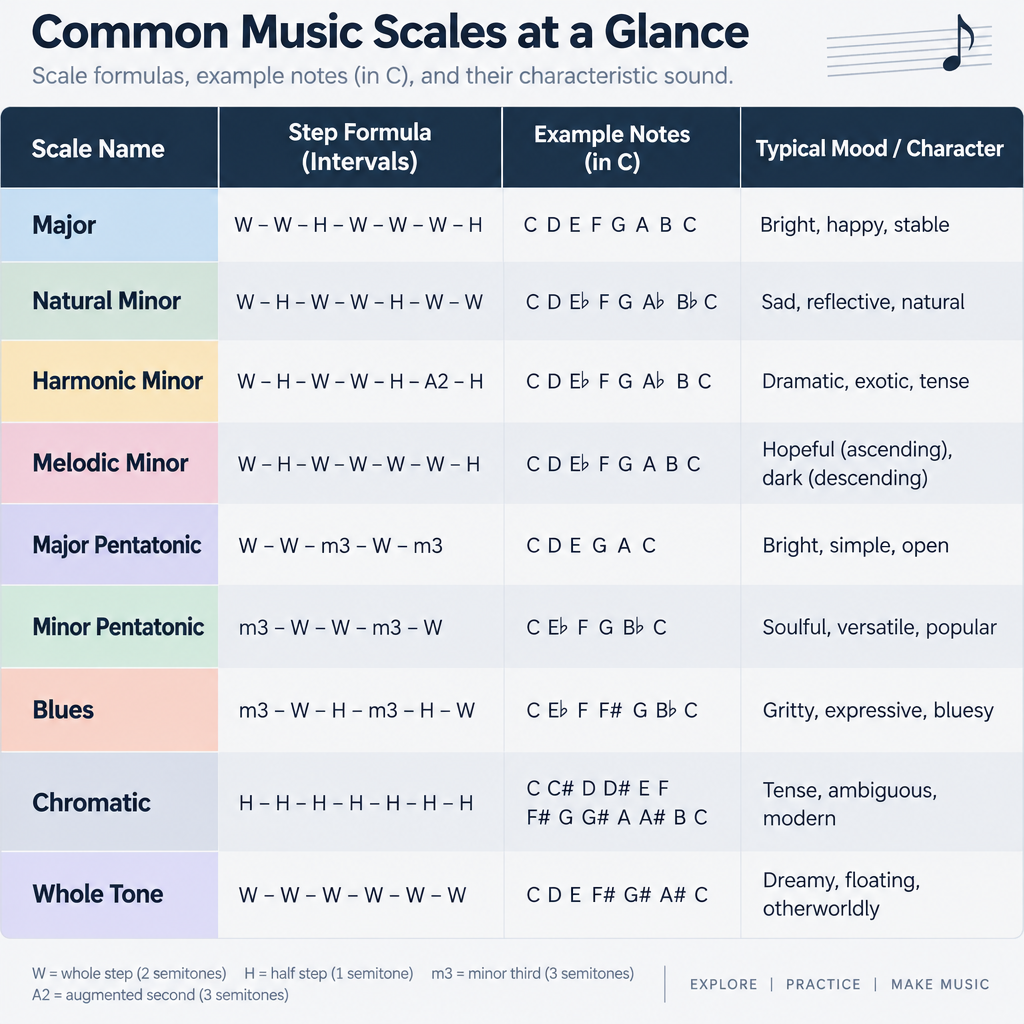
Major scale: W W H W W W H
Natural minor scale: W H W W H W W
If we start the major formula on C, we land on only white keys:
C (W) D (W) E (H) F (W) G (W) A (W) B (H) C
That is why C major is the first scale most people learn. Start the same formula on G and we need one black key, F♯, to keep the pattern intact: G A B C D E F♯ G.
How to build any music scale, step by step
Quick steps: build a major scale from any note
- Pick your root note.
- Write the seven letters in order from that root.
- Apply W W H W W W H.
- Add sharps or flats to fix any gaps.
- Check each letter appears once.
- Play it and listen.
1. Pick your root note
Choose the note you want as home. We’ll use D for this walkthrough.
2. Write the letters in order
Start on D and write every letter once: D, E, F, G, A, B, C, D.
3. Apply the formula
Now measure each gap against W W H W W W H:
- D to E is a whole step. Correct.
- E to F is a half step, but we need a whole step.
- F to G needs to be a half step.
4. Fix the gaps with sharps or flats
Raise F to F♯. Now E to F♯ is a whole step and F♯ to G is a half step. Continue up the scale. C needs to become C♯ so that B to C♯ is a whole step and C♯ to D is a half step.
Result: D E F♯ G A B C♯ D.
5. Check the spelling
Each letter should appear exactly once. That is why F major is spelled with B♭ and not A♯: F G A B♭ C D E. A♯ would give us two A’s and no B. The pitch sounds the same either way, but the correct spelling makes chord names and notation readable.
6. Play it and listen
Play it up and down slowly. A correct major scale should sound like the familiar “do re mi” pattern. If one note sounds sour, recount the steps around it.
9 types of scales, with examples and feelings
Here are nine scales worth knowing. Each one is shown from a convenient root note. The “feel” column describes how each scale is commonly heard in Western pop and film music. Context changes everything, so treat it as a starting point.
| Scale | Step formula | Example | Notes | Common feel |
|---|---|---|---|---|
| Major | W W H W W W H | C major | C D E F G A B | Bright, stable |
| Natural minor | W H W W H W W | A minor | A B C D E F G | Darker, reflective |
| Harmonic minor | W H W W H W+H H | A harmonic minor | A B C D E F G♯ | Dramatic, exotic |
| Melodic minor (ascending) | W H W W W W H | A melodic minor | A B C D E F♯ G♯ | Smooth, jazzy |
| Major pentatonic | W W W+H W W+H | C major pentatonic | C D E G A | Open, easy |
| Minor pentatonic | W+H W W W+H W | A minor pentatonic | A C D E G | Bluesy, gritty |
| Blues | W+H W H H W+H W | A blues | A C D D♯ E G | Raw, expressive |
| Chromatic | All half steps | C chromatic | All 12 notes | Tense, colourful |
| Whole tone | All whole steps | C whole tone | C D E F♯ G♯ A♯ | Dreamy, floating |
(“W+H” means a gap of three semitones.)
Major scale
This is the reference point for almost all Western theory. Chord numbers, scale degrees and modes are all described relative to it. Most pop, country and children’s songs sit here.
Natural minor scale
It uses the same notes as its relative major, starting from the sixth note. A minor shares every note with C major. The difference is where home is. Hip-hop, trap and a lot of EDM lean on natural minor.
Harmonic minor scale
This is natural minor with the seventh note raised a half step. In A, G becomes G♯. That creates a three-semitone gap between F and G♯, which gives the scale its Middle Eastern and neoclassical flavour. The raised seventh also turns the V chord from E minor into E major, which pulls much harder back to A minor.
Melodic minor scale
This is natural minor with both the sixth and seventh raised. In classical teaching it is raised on the way up and reverts to natural minor on the way down. Jazz musicians usually keep the raised version in both directions.
Major and minor pentatonic scales
These five-note scales remove the two notes most likely to clash. That makes them very forgiving for improvising, toplines and synth leads. A minor pentatonic and C major pentatonic share the same five notes.
Blues scale
This is the minor pentatonic plus one extra note, the flattened fifth (D♯ / E♭ in A). That “blue note” works best as a passing tone you slide through, not a note you sit on.
Chromatic scale
All 12 notes, each a half step apart. Nobody writes whole songs in it. It is useful for runs, risers and passing notes between scale tones.
Whole tone scale
Six notes, each a whole step apart. With no half steps there is no strong pull toward a home note. That is why it sounds suspended and dreamlike. It is often used in dream sequences and transitions.
Modes: seven moods from one set of notes
If we play only the white keys but treat a different note as home, we get the seven modes:
- Ionian (C to C): same as major
- Dorian (D to D): minor with a brighter sixth, used often in funk and lo-fi
- Phrygian (E to E): minor with a flat second, dark and tense
- Lydian (F to F): major with a raised fourth, airy and cinematic
- Mixolydian (G to G): major with a flat seventh, common in rock
- Aeolian (A to A): same as natural minor
- Locrian (B to B): unstable, rarely used as a home key
For producers, the quick trick is this: keep the drone or bass on the mode’s home note, and the same white keys will take on a new character.
The 7 scale degree names explained
Each note in a seven-note scale has a number and a technical name. Here they are in C major:
| Degree | Name | In C major | Job |
|---|---|---|---|
| 1 | Tonic | C | Home, resolution |
| 2 | Supertonic | D | Moves away from home |
| 3 | Mediant | E | Decides major or minor |
| 4 | Subdominant | F | Gentle departure |
| 5 | Dominant | G | Strongest pull back home |
| 6 | Submediant | A | Root of the relative minor |
| 7 | Leading tone | B | Wants to rise to the tonic |
In natural minor, the seventh note sits a whole step below the tonic. It is then called the subtonic instead, because it doesn’t pull upward as strongly.
Common scale degree patterns and their uses
- 5 to 1: the most final-sounding melodic move. Use it to end a phrase.
- 7 to 1: a half-step rise into the tonic. Classic for resolving tension.
- 3 to 2 to 1: a stepwise descent that sounds settled. It shows up constantly in vocal hooks.
- Ending on 2, 4 or 6: leaves the phrase hanging. This is useful for the first half of a question-and-answer melody.
Turning a scale into chords
Stack every other note of a scale and we get its chords. In C major, the seven triads are:
C, Dm, Em, F, G, Am, Bdim
In Roman numerals that is I, ii, iii, IV, V, vi, vii°. Uppercase means major, lowercase means minor, and ° means diminished. This pattern is the same for every major key. In G major the chords are G, Am, Bm, C, D, Em, F♯dim.
The I-V-vi-IV progression (C, G, Am, F in C major) is one of the most reused in pop. Write it, then improvise a melody using only the C major scale over it. Nothing will clash badly.
Using scales in a free DAW
Most piano rolls can highlight or lock to a scale. In LMMS, the piano roll has scale and chord selectors that mark a scale’s notes on the keyboard. That makes out-of-key notes easy to spot.
A practical workflow:
- Find the key of your track or sample by ear, or with a key detector.
- Set the piano roll highlight to that scale.
- Write bass and chords first on scale degrees 1, 4, 5 and 6.
- Write the melody last, landing on chord tones on strong beats.
Once a hook works, layering it gets it to the next level. Doubling the lead an octave up or using “automatic double tracking” on a vocal line makes a simple scale melody sound much bigger in the mix.
Watch out
Scale lock and snap-to-key features quietly move wrong notes to the nearest scale tone. If you switch scale later, check the notes. Some tools change the MIDI permanently rather than just the display.
Common mistakes and how to fix them
- Treating E-F and B-C like whole steps. Recount using semitones. This is the cause of most wrongly built scales.
- Spelling with repeated letters. Write F major with B♭, not A♯. Each letter should appear once.
- Confusing relative and parallel minor. A minor is the relative minor of C major, with the same notes. C minor is the parallel minor, with the same root and three different notes (E♭, A♭, B♭).
- Assuming minor always sounds sad. Tempo, rhythm and sound design matter as much as the scale. Plenty of upbeat dance tracks are in minor keys.
- Never leaving the scale. A single chromatic passing note or a borrowed chord often makes a part memorable. Learn the rules, then break them on purpose.
- Melody ending on random degrees. If a phrase feels unfinished, move its last note to 1, 3 or 5.
Why learning scales pays off
Scales speed up writing. Once we know A minor, we know which seven notes to try first, which chords fit, and which notes add tension. We stop hunting key by key. Scales also make it far easier to match samples, tune 808s and basslines to a track, and talk to session players in shared terms.
Expected result
After working through this guide, you should be able to:
- Build a major or natural minor scale from any root, on paper or in a piano roll.
- Name the scale degrees and know which ones resolve.
- Pick a scale for a mood, from pentatonic for an easy hook to harmonic minor for drama.
- Write a four-chord progression and an in-key melody over it.
A good test is to write an eight-bar melody in D major and then move it to D natural minor. Lower the third, sixth and seventh by a half step and listen to how the mood shifts.
FAQ
What are the 12 notes of the musical scale?
The 12 notes of the chromatic scale are C, C♯/D♭, D, D♯/E♭, E, F, F♯/G♭, G, G♯/A♭, A, A♯/B♭ and B. After B the pattern repeats at C, an octave higher. Every Western scale uses a selection of these 12.
What is the 7 scale in music?
A seven-note scale is called a heptatonic scale. The major and natural minor scales and their modes all have seven notes. “7” can also mean the seventh scale degree. In major it is the leading tone, a half step below the tonic, so it pulls strongly toward home.
What is the standard music scale?
In Western music the reference scale is the major scale. It follows the pattern W W H W W W H, and C major uses only the white keys. It is played in 12-tone equal temperament, usually tuned with A above middle C at 440 Hz. Most theory, including chord numbers and modes, is described in relation to it.
What are the four types of scales in music?
There is no single official list. The four most commonly taught are major, natural minor, harmonic minor and melodic minor. Some teachers group scales differently, for example as major, minor, pentatonic and chromatic. For producers, the major, minor and pentatonic families cover most modern songs.