

A weird sound generator is any instrument built to make the noises a normal synth avoids: squeals, drones, chirps and glitchy textures. The name comes from Ray Wilson’s MFOS Weird Sound Generator, a DIY noise box from Music From Outer Space. Today the term also covers free browser toys like MeowSynth and open-source plugins you can run in any DAW. These are the ten I actually use, sorted from soldering iron to browser tab.
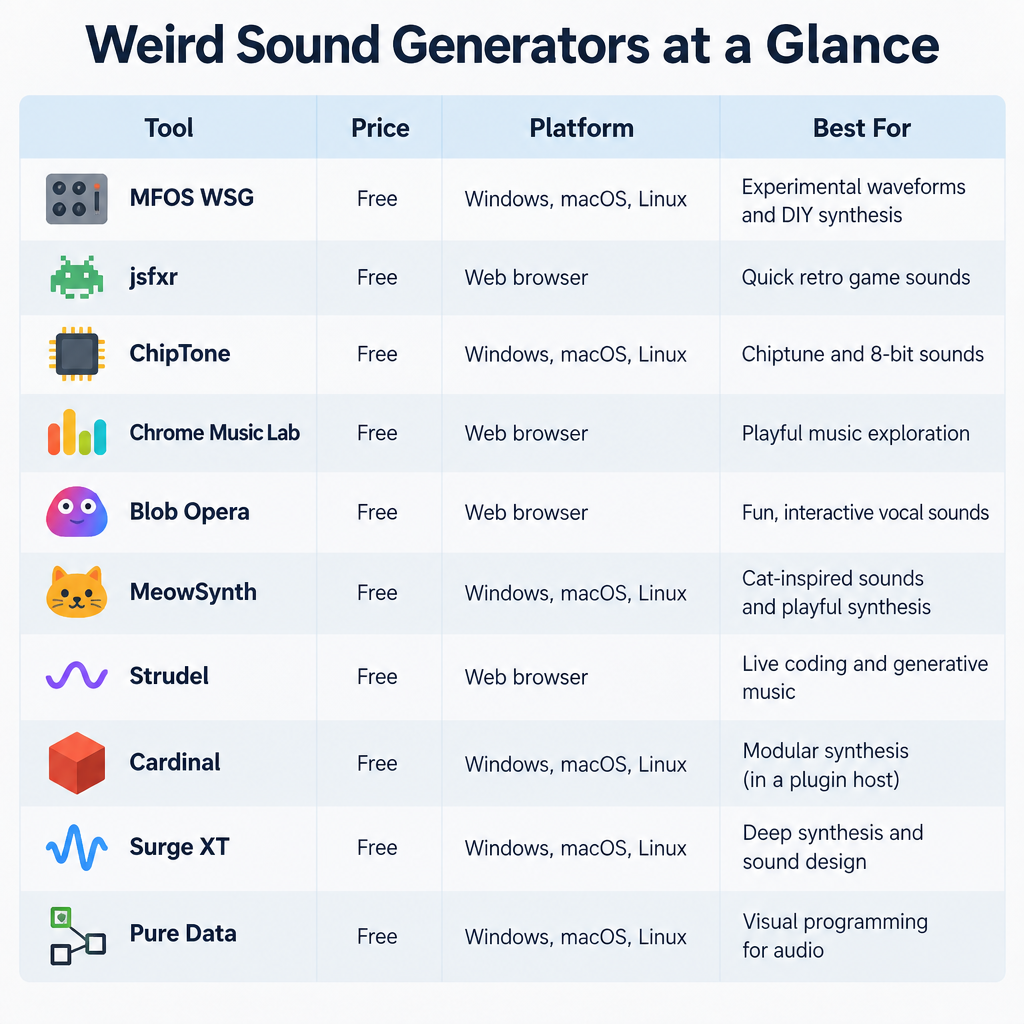
The quick comparison
I picked these for one reason: each makes a kind of strange sound the others can’t. Most of them are free, and several are open source.
| Tool | Price | Platforms | Formats | Best for |
|---|---|---|---|---|
| MFOS Weird Sound Generator | Paid DIY kit or used unit | Hardware | Line-level audio out | Hands-on analog chaos |
| jsfxr | Free | Any modern browser | WAV export | Retro game blips |
| ChipTone | Free | Any modern browser | WAV export | Deeper 8-bit sound design |
| Chrome Music Lab | Free | Any modern browser | Browser only | Voice mangling, spectrograms |
| Blob Opera | Free | Any modern browser | Browser recording | Fake choirs and wordless vocals |
| MeowSynth | Free | Any modern browser | Browser only | Pitched cat meows |
| Strudel | Free, open source | Any modern browser | Browser, audio export | Live-coded glitch patterns |
| Cardinal | Free, open source | Win, Mac, Linux, browser | LV2, VST3, CLAP, AU, standalone | Modular patching in a DAW |
| Surge XT | Free, open source | Win, Mac, Linux | VST3, AU, CLAP, LV2, standalone | Strange oscillators and effects |
| Pure Data | Free, open source | Win, Mac, Linux | Standalone | Building your own generator |
1. MFOS Weird Sound Generator
This is the box that gave the whole search term its name. Ray Wilson designed it for Music From Outer Space as a beginner-friendly build. It’s known for a simple layout: a bank of square-wave oscillators that you mix and modulate against each other, a resonant filter and an LFO. Nothing about it is precise, and that’s the point. Turn two oscillator knobs close together and you get beating, wobbling tones. Push them apart and the box screams.
It has become a classic first build because the parts are cheap CMOS logic and the soldering is forgiving. Instructables hosts a step-by-step build, and the Minneapolis musician John CS Keston documented his own unit on his AudioCookbook blog, recipes included. Those write-ups are worth reading before you warm up an iron.
Watch out
Official MFOS boards and kits have not always been easy to find, so check current availability before buying parts. If you buy a used unit, confirm which power supply it needs before you plug anything in.
The WSG runs nowhere near concert pitch. To get it into the same key as a track, a regular guitar tuner reads its dominant tone well enough to nudge the oscillator knob into place.
2. jsfxr

jsfxr is a browser port of sfxr, the open-source sound effect tool Tomas Pettersson wrote for a Ludum Dare game jam in 2007. You get preset buttons labelled Pickup/Coin, Laser/Shoot, Explosion, Powerup, Hit/Hurt, Jump and Blip/Select, plus Random and Mutate. The waveform choices are square, sawtooth, sine and noise.
What makes it weird is the Mutate button. I hit Random once, then Mutate four or five times, and end up with sounds that are halfway between a modem and a broken toy. Export is a plain WAV file, so it drops straight into the Audacity audio editor or any sampler.
3. ChipTone
ChipTone comes from SFB Games and runs in the browser. It covers the same retro ground as jsfxr but gives you more control over envelopes, effects and pitch movement. I reach for it when jsfxr’s randomness gets close but not close enough. The sounds are cleaner and easier to shape into something deliberate. It’s free and there’s no account to create.
4. Chrome Music Lab
Google’s Chrome Music Lab is a set of free browser experiments. Three of them are proper weird sound generators:
- Voice Spinner records your voice and plays it back at whatever speed and direction you spin the disc. Backwards voice at half speed sounds properly haunted.
- Spectrogram draws incoming sound as a scrolling frequency picture. It’s great for seeing why a texture sounds harsh.
- Oscillators gives you sine, square, triangle and sawtooth characters. Dragging up and down sweeps the pitch.
None of it exports audio directly. I route the browser’s output into my recorder when I want to keep something.
5. Blob Opera
Blob Opera was made by David Li for Google Arts & Culture in 2020. Four blobs sing wordless harmony, driven by a machine learning model trained on recordings of four opera singers. Drag a blob up and down for pitch and forward or back for vowel shape, and the other three harmonise around it.
Used normally, it’s a novelty. Push the blobs to the edges, though, and it starts to sound like a choir having a breakdown, which is exactly what I want for a horror cue or an ambient bed. You can record a performance inside the page.
6. MeowSynth
MeowSynth is the one people search for by name: a browser keyboard where each key plays a pitched cat meow. That’s the whole idea, and it’s funnier than it has any right to be. Played fast, the meows smear into a strange, almost vocal texture.
If you want a melody instead of chaos, pick a music scale first and stick to those keys. A pentatonic run of meows sounds intentional. Random notes sound like a cat walking across a piano.
7. Strudel
Strudel is a browser port of the TidalCycles live-coding language, released under the AGPL-3.0 licence. You type short patterns and they loop instantly. Bit-crushing, filtering and pattern manipulation are all one function away, so it’s easy to turn a simple line into a stuttering glitch loop.
A line like note("c2 eb2 g2").s("sawtooth").crush(3).room(0.8) gives a crushed, reverberant bass figure in seconds. Change the numbers while it plays and the sound changes on the next cycle.
8. Cardinal
Cardinal is a free, open-source modular synth based on VCV Rack, licensed GPL-3.0-or-later. Unlike VCV Rack 2 Free, which runs only as a standalone app, Cardinal loads as a plugin in LV2, VST2, VST3, CLAP and AU hosts. It also has a browser version. It ships with a fixed collection of modules rather than an online library, which keeps it stable inside a session.
For weird sounds, patch a couple of oscillators into each other’s frequency inputs and add a random source. You can rebuild a WSG-style patch in about five minutes.
9. Surge XT
Surge XT is the free plugin I’d keep if I could only keep one. It’s open source under GPL-3.0 and runs on Windows, macOS and Linux, with VST3, AU, CLAP and LV2 support plus a standalone app. It installs cleanly on Ubuntu or Linux Mint, which makes it a natural pick for a Linux studio.
The weird stuff lives in its oscillator types (Twist, Alias and S&H Noise are my favourites) and its effects. Nimbus is a granular processor and Combulator is a comb-filter resonator. Feed noise into Combulator and it starts ringing like metal.
Producer tip
In Surge XT, set an LFO to Sample & Hold, aim it at oscillator pitch at a high rate, then put Combulator after it. Random pitch jumps plus resonant combs make instant robot chatter.
10. Pure Data
Pure Data (Pd) is Miller Puckette’s visual programming environment, released under the BSD-3-Clause licence. You build sounds by connecting boxes, which means you can make a generator that no one else has. The learning curve is real. If you want Pd patches inside your DAW, plugdata wraps it as a plugin.
Recipes for sound design
These are starting points I’ve written down from my own sessions. Treat the values as places to begin, then move them by ear.
| Target sound | Tool | Starting settings |
|---|---|---|
| Haunted drone | Audacity Paulstretch | 2 s vocal clip, stretch factor 20, time resolution 0.25 s |
| Alien radio chatter | Chrome Music Lab Voice Spinner | Record speech, spin backwards at slow speed |
| Glitch hit | jsfxr | Random once, Mutate 4 times, square wave, export 44.1 kHz |
| Metallic ring | MFOS WSG | Two oscillators tuned close, filter resonance high |
| Granular cloud | Surge XT Nimbus | Feed a sustained pad, raise density and texture |
| Cat choir | MeowSynth | Three keys a fifth apart, held and re-triggered |
Quick steps: capture a browser texture
- Open the browser tool and set system volume to about 70 percent.
- Arm a recording track in your DAW or Audacity.
- Set the project to 44.1 kHz or 48 kHz.
- Play for longer than you need.
- Trim, normalise to -1 dB and save as WAV.
Once you have a library of these clips, a digital audio workstation lets you layer, pitch and loop them into proper tracks.
Buying a used hardware generator
eBay, Reverb and the ModularGrid marketplace all list used weird boxes, including built WSGs, Atari Punk Consoles and boutique drone synths. Before buying, I ask for a recent audio clip where every knob gets turned. Scratchy pots and dead switches show up immediately. Then I check that the seller includes the right power supply, since homebuilt units vary.
YouTube demos help too. Sort out the polished promo videos and look for long, unedited jams. They show what the box sounds like when nobody is trying to make it sound good.
Licences and accounts at a glance
| Tool | Licence | Account needed |
|---|---|---|
| jsfxr | Open source (sfxr port) | No |
| Strudel | AGPL-3.0 | No |
| Cardinal | GPL-3.0-or-later | No |
| Surge XT | GPL-3.0 | No |
| Pure Data | BSD-3-Clause | No |
| VCV Rack 2 Free | GPL-3.0 | VCV account for library |
| Chrome Music Lab, Blob Opera, ChipTone, MeowSynth | Free, closed | No |
None of the free tools above add watermarks to exported audio. The only upsell in the group is VCV Rack, whose paid Pro edition adds the plugin version that Cardinal gives you free.
FAQ
What is the MFOS Weird Sound Generator?
It’s a DIY analog noise box designed by Ray Wilson of Music From Outer Space. It uses CMOS-based square-wave oscillators and a resonant low-pass filter, with one of its own oscillators running slowly to modulate the others, and it’s a popular first electronics build.
Is there a free weird sound generator online?
Yes. jsfxr, ChipTone, Chrome Music Lab, Blob Opera, MeowSynth and Strudel all run free in a browser with no install. jsfxr and ChipTone export WAV files directly.
What is MeowSynth?
MeowSynth is a free browser keyboard that plays pitched cat meows. It’s a joke instrument, but stacked meows make surprisingly usable textures.
Can I use these sounds in released music?
The sounds you create with the open-source tools are yours. For closed browser toys, check each site’s terms before releasing a track built on their output.
Which free plugin gets closest to the WSG sound?
Cardinal, because you can patch oscillators into each other just like the hardware. Surge XT gets close with its S&H Noise oscillator and a resonant filter.