

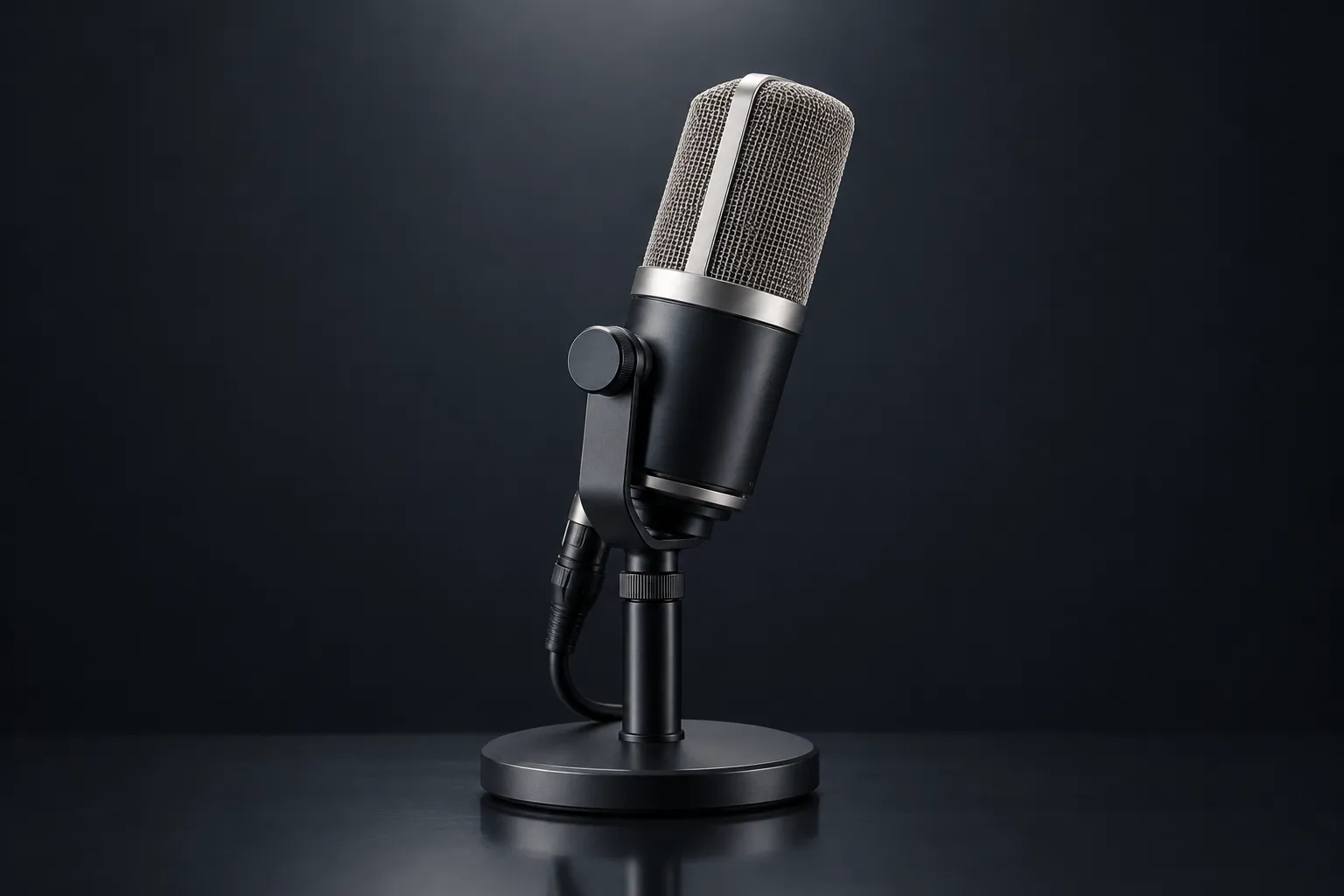
A $249 Rode NT1 5th Gen is rated at 4 dBA self-noise. A Neumann U 87 Ai costing about 18 times as much is rated at 12 dB-A in cardioid, so a higher price does not always buy a quieter condenser mic. A condenser mic is the sensitive, powered microphone used for studio vocals and acoustic instruments. That sensitivity means it records your guitar or voice in fine detail, and it also records your room, your PC fan and the traffic outside.
Key takeaways
- A condenser picks up more detail and more room noise than a dynamic mic. In an echoey or noisy room, a dynamic often sounds better.
- XLR condensers need 48 V phantom power (P48: 48 V ±4 V, 10 mA maximum per IEC 61938). USB models power themselves from the computer.
- Use self-noise, sensitivity and max SPL to compare models. Budget mics now publish all three.
- Free tools such as noise-repellent, Bertom Denoiser Classic and Audacity can clean up light room noise, but they cannot fix a bad room.
Fact-checked
We checked these key facts against the sources named, on November 09, 2026:
- The AKG C114 gives you switchable patterns for about $200–$229 (source: soundpro.com)
- The Neumann TLM 103 (7 dB-A, 138 dB) is the classic single-pattern LDC for vocals (source: media.sweetwater.com)
- Earthworks microphones can draw the full 10 mA that the IEC 61938 standard allows, roughly five times as much (source: earthworksaudio.com)
- Many sheets quote the padded figure: the AKG C214 is rated 136 dB without its pad and 156 dB with the 20 dB pad engaged (source: bhphotovideo.com)
- The NT1 5th Gen records 32-bit float at 48, 96 or 192 kHz only over USB, and its onboard APHEX processing works only at 48 kHz (source: edge.rode.com)
Condenser mic: the 30-second answer
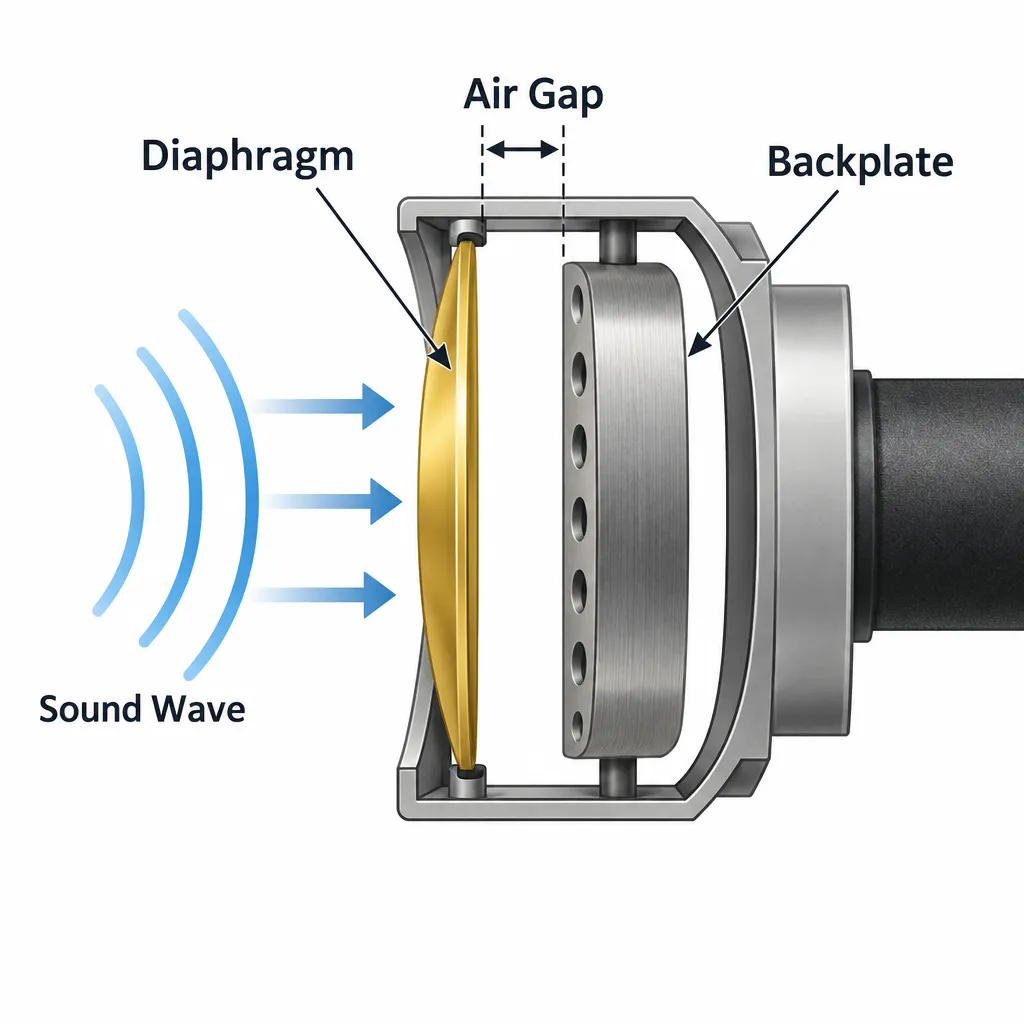
A condenser microphone works like a capacitor (the British name is “capacitor microphone”). A very thin conductive diaphragm sits close to a fixed metal backplate, and sound moves the diaphragm, which changes the voltage between the two. The design needs power, responds quickly to transients, catches high-frequency detail and hears everything in the room.
You should buy one if you record in a reasonably quiet room and want detailed vocals, acoustic guitar, piano or voice-over. If you record in a bare-walled bedroom with a loud computer, buy a dynamic mic instead, and do the same for loud stages. Dynamic mics need no power, survive drops, and pick up much less of the room.
How a condenser microphone works
Most condenser capsules use a diaphragm of gold-sputtered mylar a few microns thick, held a fraction of a millimetre from a backplate. The two plates carry an electrical charge. When sound pushes the diaphragm, the distance between the plates changes, and so does the capacitance. The result is a tiny voltage signal that follows the sound wave.
The capsule’s signal is very small and its impedance is very high, so a cable run would ruin it. Every condenser therefore has an impedance converter (a transistor circuit or a vacuum tube) inside the body, and that circuit is the main reason it needs power. According to Neumann’s Homestudio Academy, the company has built condenser microphones since 1928. Neumann introduced P48 phantom power in the late 1960s, when transistors replaced tubes.
Did you know?
According to Neumann’s own knowledge base, the 48 V phantom power on almost every audio interface today was a Neumann invention from the late 1960s. The company had already been making condenser mics for four decades by then.
True condenser vs electret (pre-polarised)
A “true” or externally polarised condenser gets the charge for its capsule from a supply voltage. In an electret condenser, the charge is built permanently into a material on the diaphragm or backplate, so the capsule needs no polarising voltage. The impedance converter still needs power, though. Electrets are cheaper to make and power, and they are used in lavaliers, headsets, phone mics and many budget studio mics.
Electret does not mean bad. AKG’s new C104, launched in 2026, uses a 22 mm electret capsule and is rated at 14 dB(A) self-noise. The C114 that sits above it uses a 26 mm dual-diaphragm true-condenser capsule, which is what gives it switchable patterns.
Solid-state vs tube (valve) condensers
Solid-state condensers use transistors and run on phantom power. Tube condensers such as the Sony C-800G use a vacuum tube as the impedance converter. They need more voltage and current than P48 can supply, so they come with their own external power supply and a multi-pin cable. The tube adds a gentle harmonic colour that many engineers like on vocals, but tube mics cost more and run warm. For a first home-studio mic, a solid-state model is the sensible choice.
Large-diaphragm vs small-diaphragm
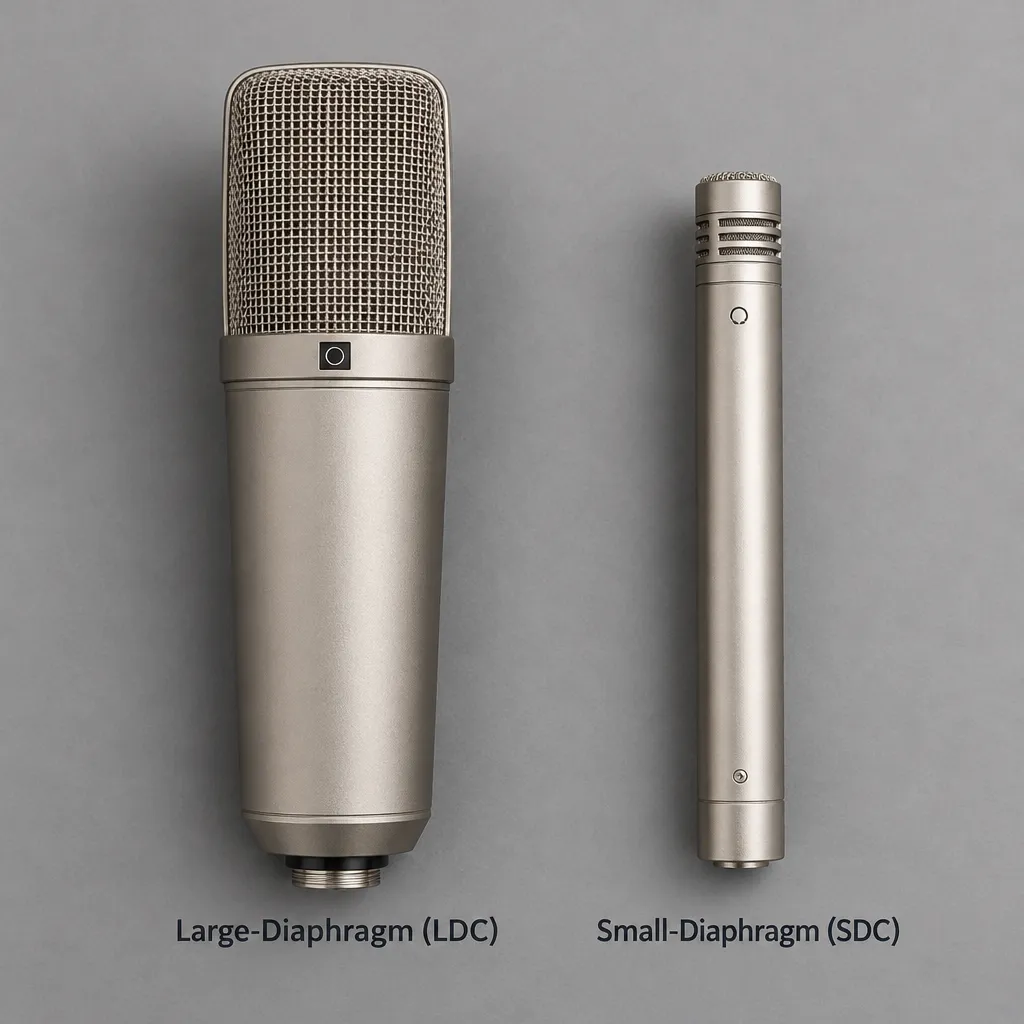
Large-diaphragm condensers (LDCs, usually around 1 inch, like the Rode NT1 5th Gen) are mostly side-address. You sing into the side of the body, not the end. They have a slightly larger-than-life sound with a little colour, and they are the default for vocals and voice-over. Small-diaphragm or “pencil” condensers (SDCs, about ½ inch, like the Rode NT5, Rode M5, Shure SM81 and AKG C151) are end-address. Their off-axis response is more even, which suits acoustic guitar, strings, drum overheads and stereo pairs. Brands often sell them as matched pairs for that reason.
Condenser vs dynamic (the “normal” mic)
A dynamic mic works like a speaker in reverse: a coil attached to the diaphragm moves inside a magnet. It needs no power and handles rough treatment. A condenser is more sensitive and more detailed. A cheap condenser can still be noisier, and harsher in a bad room, than a good dynamic such as the Sennheiser MD 441.
| Factor | Condenser | Dynamic | Who wins for home recording |
|---|---|---|---|
| Sensitivity | High (AT2020: 14.1 mV/Pa) | Low, needs more preamp gain | Condenser in a quiet room |
| Transients and high-end detail | Fast, airy, detailed | Smoother, softer top end | Condenser for acoustic sources |
| Room and background pickup | High | Low when close-miked | Dynamic in untreated rooms |
| Power | 48 V phantom, USB or tube PSU | None | Dynamic (simpler) |
| Durability | Sensitive to drops and humidity | Very rugged | Dynamic |
| Self-noise | Present, varies by model | Effectively none | Depends on model |
| Feedback risk live | Higher | Lower | Dynamic on stage |
Which is better for vocals at home?
A large-diaphragm condenser gives the better vocal if your room is fairly quiet and not echoey. Recorded 15–20 cm away with a pop filter, it captures breath, consonants and air that a dynamic softens. If clapping in your room produces a ringing echo, a dynamic held 5 cm from your mouth will give you a cleaner, more usable take. Commercial releases can be made either way.
Which is better for podcasts and streaming?
For most home podcasters and streamers, a dynamic is the better choice. Speech recorded close to a dynamic mic hides keyboard clicks, game audio and a second person in the room. A condenser wins for solo voice-over in a treated booth or closet, where you want the fullest, most natural voice.
Producer tip
Before you buy, clap once in the room you will record in. If you hear a ringing echo, a close-miked dynamic will probably sound better than any condenser until you add some soft treatment.
Phantom power explained with real numbers
Phantom power sends DC voltage down the same balanced XLR cable that carries the audio. The IEC 61938 standard defines P48 as 48 V ±4 V, fed through 6.81 kΩ resistors on each signal leg, with a maximum of 10 mA per microphone. The DPA Microphones Mic University guide gives the rated available current as 7 mA, with 10 mA as the ceiling.
| Item | Voltage | Current |
|---|---|---|
| IEC 61938 P48 standard | 48 V ±4 V | 7 mA rated, 10 mA maximum |
| Original DIN 45596 limit | 48 V | 2 mA |
| Audio-Technica AT2020 | 48 V phantom | 2 mA typical |
| Shure SM81 | 11–52 V phantom | 1.2 mA maximum |
| Neumann transformerless designs | P48 | 2–4 mA |
| Most Shure KSM series | P48 | 5–6 mA |
| Earthworks mics | P48 | Up to 10 mA |
| Tube condensers (e.g. Sony C-800G) | External PSU | Not drawn from interface |
These numbers matter most for USB-bus-powered interfaces. A two-input interface powered only by your laptop’s USB port has a fixed power budget. One AT2020 at 2 mA is no problem. Two power-hungry mics near the 10 mA limit can make the supply sag, which shows up as distortion, low output or crackles. If you run several condensers on a small interface, use its power adapter if it has one, or choose mics with low current draw. The same question comes up when you look at whether you need a separate mic preamp for home recording: dedicated preamps usually have more robust phantom supplies.
Did you know?
The AT2020 draws only about 2 mA of phantom power. Earthworks microphones can draw the full 10 mA that the IEC 61938 standard allows, roughly five times as much.
Do USB condenser mics need phantom power?
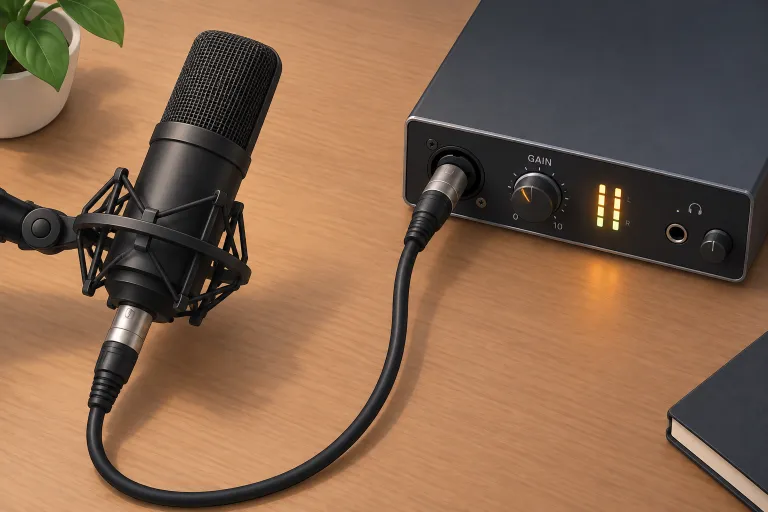
No. A USB condenser powers itself and its built-in preamp and converter from the computer’s USB port. The Rode NT1 5th Gen has both an XLR output and a USB-C output. You can run it over XLR with phantom power, or plug it straight into a computer without an interface. The Rode NT1 Signature Series is the XLR-only branch of the same family.
USB does carry some limits that product pages bury. The NT1 5th Gen records 32-bit float at 48, 96 or 192 kHz only over USB, and its onboard APHEX processing works only at 48 kHz. Similar model names can also hide different mics. The Audio-Technica AT2020USB-X is a USB-C model rated at 136 dB max SPL, while the XLR AT2020 is rated at 144 dB, so the two are not the same capsule and circuit in a different box.
Is phantom power safe for my dynamic or ribbon mic?
A properly wired dynamic mic ignores phantom power, because the voltage appears equally on both signal legs and cancels out. Modern active ribbon mics need phantom power. Vintage passive ribbons can be damaged if phantom power is switched on with a faulty cable or patch bay, or if the mic is hot-plugged.
Watch out
Turn phantom power on only after the XLR cable is connected and with your monitors turned down. Never plug or unplug a passive ribbon mic while 48 V is on.
What condenser mics are used for
Condensers are the default studio mics for anything quiet, detailed or acoustic. Each job tends to suit a particular type and pattern.
Studio vocals
A large-diaphragm cardioid is the standard choice. Popular examples include the AT2020, Rode NT1 5th Gen, AKG C214 and Neumann TLM 103. Multi-pattern models such as the AKG C114, AKG C414 XLII and XLS, and Neumann U 87 Ai let you switch to omni for a group vocal or figure-8 for a duet.
Acoustic instruments and overheads
Small-diaphragm pencils handle acoustic guitar, piano, strings and drum overheads. Matched pairs such as the Rode NT5, Rode M5 and sE Electronics sE7 or sE8 exist because stereo techniques need two mics that respond the same way. The Shure SM81 has been a staple for decades on guitar, piano and cymbals. It is rated at 16 dB A-weighted self-noise and 136 dB max SPL, or 146 dB with its 10 dB pad.
Podcasting, streaming and voice-over
Voice-over artists use large-diaphragm condensers in treated booths. Podcasters in ordinary rooms often get better results from dynamics, as covered above. USB condensers make sense for a one-person setup at a desk with no interface.
Film, broadcast and boundary use
Shotgun mics are long, highly directional condensers used on boom poles for film dialogue. Lavaliers are tiny electret condensers clipped to clothing. Boundary mics such as the Shure Beta 91A lie flat on a surface, inside a kick drum, on a piano lid or on a conference table. Clip-on instrument condensers such as the Shure WB98H/C plug into wireless bodypacks for horns on stage, which is a specialist live tool rather than a home-studio purchase.
The disadvantages nobody on a product page tells you
The sensitivity that makes a condenser sound detailed is also its biggest drawback at home. Here are the trade-offs, roughly in order of how often they cause trouble:
- Room sound. Hard walls send reflections back into the mic, and they come out as a boxy, hollow tone that EQ cannot remove.
- Background noise. Keyboard clicks, PC fans, air conditioning, fridges and traffic all end up on the recording. When you hear “my condenser picks up everything,” the mic is usually working as designed and the room is the problem.
- Self-noise on cheap models. Every condenser adds a little hiss of its own, and a hiss you hear while recording quiet sources often comes from the mic. If an older budget LDC such as an MXL 770 seems to hiss, check gain staging and cables before you assume it is broken. A faulty cable, a dirty USB power supply or too much preamp gain causes more of these complaints than a dead capsule.
- Fragility and humidity. Drops can damage the capsule. Humid rooms and breath moisture can cause crackling until the mic dries out, so store it in its case or bag.
- Feedback live. A sensitive mic close to loud wedges will feed back sooner.
- Hidden costs. You also need an interface with phantom power (for XLR), a stand, a pop filter and ideally a shock mount. A pop filter is essential for vocals. A shock mount matters if your desk or floor transmits bumps.
Condenser mics live: can you use one on stage?
Yes, and handheld condensers do exist for live vocals. They suit quiet, controlled stages and singers who want a more open sound. On loud stages, most engineers still choose dynamics, because a dynamic picks up less of the drums, guitar amps and monitors around the singer.
What mic does Billie Eilish use on stage?
Billie Eilish is famous for singing quietly, so you might expect a condenser. The most recent detailed report, from her 2022 world tour in ProSoundWeb (an established pro-audio trade publication), says she used a dynamic capsule. It was an sE Electronics V7 MC1 supercardioid on a Shure Axient Digital wireless transmitter. FOH engineer Drew Thornton chose it for its low noise and its rejection of stage bleed. Live Sound International reported that her band all used Shure PSM 1000 in-ear monitors, which keeps loud wedges off the stage altogether. The lesson for home users is that a quiet voice needs rejection of everything else, not extra sensitivity.
How to read a condenser spec sheet
Three numbers tell you most of what you need: self-noise, sensitivity and max SPL. Polar pattern tells you the rest. Here is how to read each one, using real mics as worked examples.
Self-noise: why 4 dBA vs 20 dB matters
Self-noise (also called equivalent noise level) is the hiss the mic produces with no sound reaching it, given as an equivalent SPL and usually A-weighted. Lower is better. The NT1 5th Gen is rated at 4 dBA, the Neumann TLM 103 at 7 dB-A, the U 87 Ai at 12 dB-A (cardioid) and the AT2020 at 20 dB SPL.
That 16 dB gap between the NT1 and the AT2020 is clearly audible on whispered voice-over or a softly fingerpicked guitar recorded from a distance. On a sung vocal at 15 cm, both noise floors sit far below your voice. In most home rooms the ambient noise is louder than either figure, so the room, not the mic, sets your noise floor. Spending more for low self-noise only pays off once the room is quiet.
Sensitivity: how much gain you will need
Sensitivity is the output voltage at 94 dB SPL (1 pascal), given in mV/Pa or dBV. The NT1 5th Gen produces 25 mV and the TLM 103 23 mV/Pa. The AT2020 produces 14.1 mV (-37 dB). Higher sensitivity means less preamp gain, and less gain means less preamp hiss. That matters if your interface’s preamps are noisy near the top of the gain knob.
Max SPL: when the pad figure is quoted
Max SPL is the loudest sound the mic handles before reaching a stated distortion level. Check that threshold before you compare. The AT2020’s 144 dB is measured at 1% THD, while Neumann quotes 117 dB for the U 87 Ai at a stricter 0.5% THD, or 127 dB with its pre-attenuation switch on. Many sheets quote the padded figure: the AKG C214 is rated 136 dB without its pad and 156 dB with the 20 dB pad engaged. For vocals, anything above about 130 dB is plenty. Kick drums, guitar cabinets and brass are where the number matters.
Polar patterns: cardioid, omni, figure-8
Cardioid picks up the front and rejects the back. It is the right choice for most home recording, because you can point the dead side at your computer or a noisy window. Omni hears all directions equally, so it suits a room you like the sound of or a group around one mic. Figure-8 hears front and back and rejects the sides, which is useful for two-person interviews or mid-side stereo. Multi-pattern mics switch between these patterns using a dual-diaphragm capsule.
Condenser mics worth knowing in 2026, by budget
The models below were chosen on three things: published specs (self-noise and max SPL from manufacturer or dealer spec sheets), verifiable US pricing, and how often each one appears in home and pro studios. Every row is an XLR mic unless noted otherwise.
| Mic | Type | Connection | Self-noise | Max SPL | Patterns | Price (US) |
|---|---|---|---|---|---|---|
| AKG C151 | Small-diaphragm | XLR | 21 dB(A) | 147 dB | Cardioid | $129 MSRP ($99 AKG store) |
| AKG C104 | Large-diaphragm electret | XLR | 14 dB(A) | 143 dB | Cardioid | $129 MSRP ($99 AKG store) |
| Audio-Technica AT2020 | Side-address condenser | XLR | 20 dB SPL | 144 dB (1% THD) | Cardioid | About $99 |
| AKG C114 | Large-diaphragm, dual capsule | XLR | 12 dB(A) | 145 dB | Multi-pattern | $229 MSRP ($199 AKG store) |
| Rode NT1 5th Gen | Large-diaphragm | XLR and USB-C | 4 dBA | 142 dB | Cardioid | $249 |
| AKG C214 | Large-diaphragm | XLR | 13 dB-A | 136 dB (156 dB padded) | Cardioid | $449 AKG store |
| Neumann U 87 Ai | Large-diaphragm | XLR | 12 dB-A (cardioid) | 117 dB (127 dB padded) | Omni, cardioid, figure-8 | $4,399 MSRP |
Under $150
The 2026 AKG C-Series is the newest option at this level. Announced at NAMM in January 2026, it was HARMAN’s first new AKG studio range in eight years, and MusicTech lists the C104 and C151 at $129 MSRP. The AT2020 is still worth buying if you want a proven, low-current cardioid. Its 20 dB self-noise is the main limit, and it only becomes a problem with quiet, distant sources.
$150–$500
The Rode NT1 5th Gen is the low-noise choice in this range, and its USB-C output lets it double as a desktop mic. The AKG C114 gives you switchable patterns for about $200–$229. The AKG C214 is the step toward a classic studio sound, with a 20 dB pad for loud sources. The Audio-Technica AT4040 is the usual upgrade path for AT2020 owners.
Pro tier
The AKG C414 XLII and XLS are listed at $1,099 on AKG’s store, down from $1,299. The Neumann TLM 103 (7 dB-A, 138 dB) is the classic single-pattern LDC for vocals. The U 87 Ai at $4,399 MSRP (often around $3,750 street) is the reference studio mic, bought for its tone and three patterns rather than its noise figure. Studio condenser lines such as Audix’s A131 ($249) to A127 ($2,099) cover the same range, though Audix’s own store currently lists the whole line as sold out.
Getting a clean take in an untreated room
You can get usable condenser recordings in an ordinary room by reducing what the mic hears from the room and getting more of your voice into it.
Quick steps: a cleaner condenser take
- Switch off fans, AC and noisy appliances.
- Face into soft furnishings, away from bare walls.
- Sing 15–20 cm from the mic, behind a pop filter.
- Point the mic’s rear at your computer.
- Set gain for about -12 dBFS average.
- Record 5 seconds of room tone first.
Distance first. Every halving of distance raises your voice relative to the room. Moving from 40 cm to 15 cm does more than any plugin.
Use the dead side. A cardioid rejects sound from directly behind. Put the computer, the window or the door behind the mic.
Soften the reflections. Thick blankets or duvets hung behind you and to the sides, a wardrobe full of clothes, or a sofa and rug all cut the boxy reflections that make home vocals sound amateur.
Gain staging. Aim for an average around -12 dBFS with peaks well below 0 dBFS. If a USB condenser clips, lower the gain. If it hisses, move closer before you raise the gain. A noisy recording made too quietly and then normalised brings the hiss up with it.
The Windows boost trap. Open Control Panel > Sound > Recording, select your mic, click Properties, then the Levels tab. If “Microphone Boost” is set to +20 dB, set it to 0 and raise the level in your interface or DAW instead. Many USB mics do not show this option, but where it exists it is a common cause of a hissy condenser. For the rest of the signal path, a beginner’s guide to the digital audio workstation explains input monitoring and track arming.
Producer tip
Record about 5 seconds of silence (room tone) at the start of every take. Free denoisers need a clean sample of your room’s noise to work well.
Clean up condenser recordings with free and open-source software
Free noise reduction works well on steady noise such as hiss, fan hum and AC rumble, provided you use it lightly. It cannot remove room echo, dogs barking or a door slam. For those problems, fix the room or re-record.
Free denoisers compared
| Tool | Licence | Platforms/format | Mode | Best for |
|---|---|---|---|---|
| noise-repellent (libspecbleach) | Free, open source | LV2, Linux (e.g. Ardour) | Adaptive voice mode or manual noise profile | Linux users and live voice |
| Bertom Denoiser Classic | Free | Plugin for macOS, Windows, Linux | Zero-latency real-time | Light hiss removal in any DAW |
| Audacity Noise Reduction | Free, open source (GPL) | Built into Audacity, Win/Mac/Linux | Offline, profile-based | Podcasts and voice-over edits |
In Audacity, select your room tone and go to Effect > Noise Removal and Repair > Noise Reduction, then click Get Noise Profile. Select the whole take, open the effect again and click OK. A good starting point is about 12 dB of reduction rather than the maximum. The noise profile is not saved when you close Audacity, so capture a new one each session. Audacity’s manual says plainly that noise reduction adds some distortion.
Many people ask which free noise reduction works without making the voice sound robotic. All three can do it, if you remove less noise than seems possible. The warbly, underwater sound comes from aggressive settings. Reduce the noise until the hiss stops being distracting, not until it is gone, and compare with bypass at normal listening volume.
A free vocal chain for condenser recordings
- Denoise lightly, using one of the tools above with a room-tone profile.
- Apply a high-pass filter around 80 Hz to remove rumble from desks, traffic and handling. In Audacity this is Effect > EQ and Filters > High-Pass Filter.
- Compress gently (Effect > Volume and Compression > Compressor in Audacity) to even out the level.
- De-ess if the condenser’s bright top end makes “s” sounds harsh.
- Add width later, for example with automatic double tracking on backing vocals, once the dry take is clean.
If you find yourself pushing the denoiser past roughly 12–15 dB on every take, stop adjusting plugins. Move closer, hang a blanket, or switch to a dynamic mic for that room.
FAQ
What are condenser mics used for?
Studio vocals, voice-over, acoustic guitar, piano, strings, drum overheads, choirs and film dialogue (shotgun and lavalier types). Boundary condensers cover kick drums, piano lids and conference tables.
What is the difference between a normal mic and a condenser mic?
The “normal” mic most people know, such as a stage vocal mic, is a dynamic: it needs no power, is rugged, and picks up little room sound. A condenser needs power, is more sensitive and detailed, and picks up much more of the room.
What are the disadvantages of condenser mics?
They pick up room reflections and background noise, need phantom or USB power, are more fragile and humidity-sensitive, add self-noise on cheaper models, and feed back more easily on stage.
What mic does Billie Eilish use on stage?
The latest detailed report, from her 2022 world tour, describes an sE Electronics V7 MC1 dynamic supercardioid capsule on a Shure Axient Digital transmitter. Her front-of-house engineer chose it for low stage bleed.
Do condenser mics need phantom power?
XLR solid-state condensers need 48 V phantom power from your interface or mixer. Tube condensers use their own power supply, and USB condensers draw power from the computer.
Can you use a condenser mic for live performance?
Yes, on quiet stages, for acoustic instruments, choirs and overheads, or with handheld vocal condensers. On loud stages a dynamic usually gives more gain before feedback.
Is a condenser mic good for vocals at home?
Yes, if the room is reasonably quiet and not echoey. In an untreated, noisy room a close-miked dynamic usually sounds cleaner.
Condenser vs dynamic: which is better for podcasting?
A dynamic is better for most home podcasts because it rejects keyboards, fans and other people. A condenser suits solo voice-over in a treated space.
Does a USB condenser mic need an audio interface?
No. The interface is built in, so it plugs straight into a computer. Hybrid models like the Rode NT1 5th Gen also have an XLR output for later use with an interface.
Is a condenser mic worth it in an untreated room?
Only if you can control the room: get close to the mic, add blankets and soft furnishings, and turn off fans. If you cannot, buy a dynamic now and a condenser once the room is treated.
Is the AT2020 still worth it, or should I spend more?
It is still a solid, low-current mic for close vocals and guitar. If you record quiet sources or voice-over, the 4 dBA NT1 5th Gen or the multi-pattern AKG C114 are worth the extra money.
Do I need a pop filter and shock mount with a condenser?
A pop filter is essential for vocals. A shock mount is strongly recommended if your stand is on a desk or a hollow floor.
Before you choose any of these mics, spend ten minutes in the room you will record in. Clap, listen to the fans, and record five seconds of silence through whatever mic you already have. That recording tells you whether a condenser will reward you or a dynamic will serve you better.
Keep reading
Free music tools
Editorial notes
- Fact-checked by Vivian Osei against the sources listed below before publication.
- Published
Sources (8)
- Phantom power – Wikipedia (en.wikipedia.org)
- Know the basics about phantom power – DPA Microphones (dpamicrophones.com)
- What is a condenser microphone? – Neumann Homestudio Academy (neumann.com)
- Audio-Technica AT2020 specifications (specdb.net)
- Audio-Technica AT2020USB-X specifications (specdb.net)
- RODE NT1 5th Gen – Long & McQuade (long-mcquade.com)
- RODE NT1 5th Generation – Musician's Friend (musiciansfriend.com)
- Neumann U 87 Ai – SoundPro (soundpro.com)