

Chord movement is how one chord leads to the next. In theory it comes down to three things: how far the root travels (by a fifth, a third, a second or a tritone), which notes the two chords share, and how smoothly each voice moves. On an instrument it means getting your fingers from one shape to the next without a gap. This guide covers both, with a root-motion chart, voice-leading rules, seven progressions broken down, practice routines for guitar and piano, and a short workflow that uses only free software.
Key takeaways
- Root motion down a fifth (V to I) is the strongest move in tonal music. Thirds sound soft and seconds sound plain.
- Chords a third apart share two notes. Chords a step apart share none, so every voice has to move.
- Smooth movement comes from holding shared notes and moving the other voices by step.
- On guitar, practise the change without strumming at about 60 BPM before you speed up. On piano, change inversions instead of moving your hand.
- You can write, hear and test every movement here in MuseScore Studio 4.7.5, LMMS and Hooktheory Trends for free.
Fact-checked
We checked these key facts against the sources named, on November 13, 2026:
- At 120 BPM in 4/4, one chord per bar means a new chord every two seconds (source: musictheory.net)
- The 1931 standard “All of Me” by Seymour Simons and Gerald Marks is a clear example (source: loc.gov)
- In a Markov-chain analysis of Hooktheory’s TheoryTab song database, G (the V chord) was the most common chord to follow C (the I chord), coming next 31% of the time (source: hooktheory.com)
- The 38-song performance is the one most often cited. “Let It Be” by the Beatles (C–G–Am–F) and “Don’t Stop Believin’” by Journey (E–B–C♯m–A) both use the progression (source: openculture.com)
- Pick a starting chord in Hooktheory Trends and note the most likely next chords (source: hooktheory.com)
What chord movement means (and the two kinds you need)
Chord movement has two meanings. Harmonic movement is the way the sound travels from chord to chord. Physical movement is the way your hands shift between shapes. Producers need the first to write progressions that go somewhere. Players need the second to perform them cleanly. (If you came here for the daylily variety called Chord Movement, this page is about music.)
Harmonic movement vs harmonic rhythm
Harmonic movement describes where the chords go. Harmonic rhythm describes how often they change. One pop loop might hold each chord for a full bar. A jazz tune might change chords twice a bar. At 120 BPM in 4/4, one chord per bar means a new chord every two seconds. Two chords per bar halves that.
Harmonic rhythm affects the feel as much as chord choice does. Composers often speed it up near a cadence, so a phrase that has held one chord per bar packs two or three into its last bar. That acceleration tells the listener an ending is coming. If you keep the harmonic rhythm flat, an otherwise strong progression can feel static.
Physical chord shifting
Physical chord movement is the time and accuracy of the change itself. A guitarist moving from C to G has to lift, travel and land three or four fingers in the gap between two beats. A pianist moving from C to F can relocate the whole hand, or keep it still and change one or two fingers. The theory below also explains why some changes are easy for your hands. Chords that share notes usually share finger positions.
The chord movement chart: root motion by interval
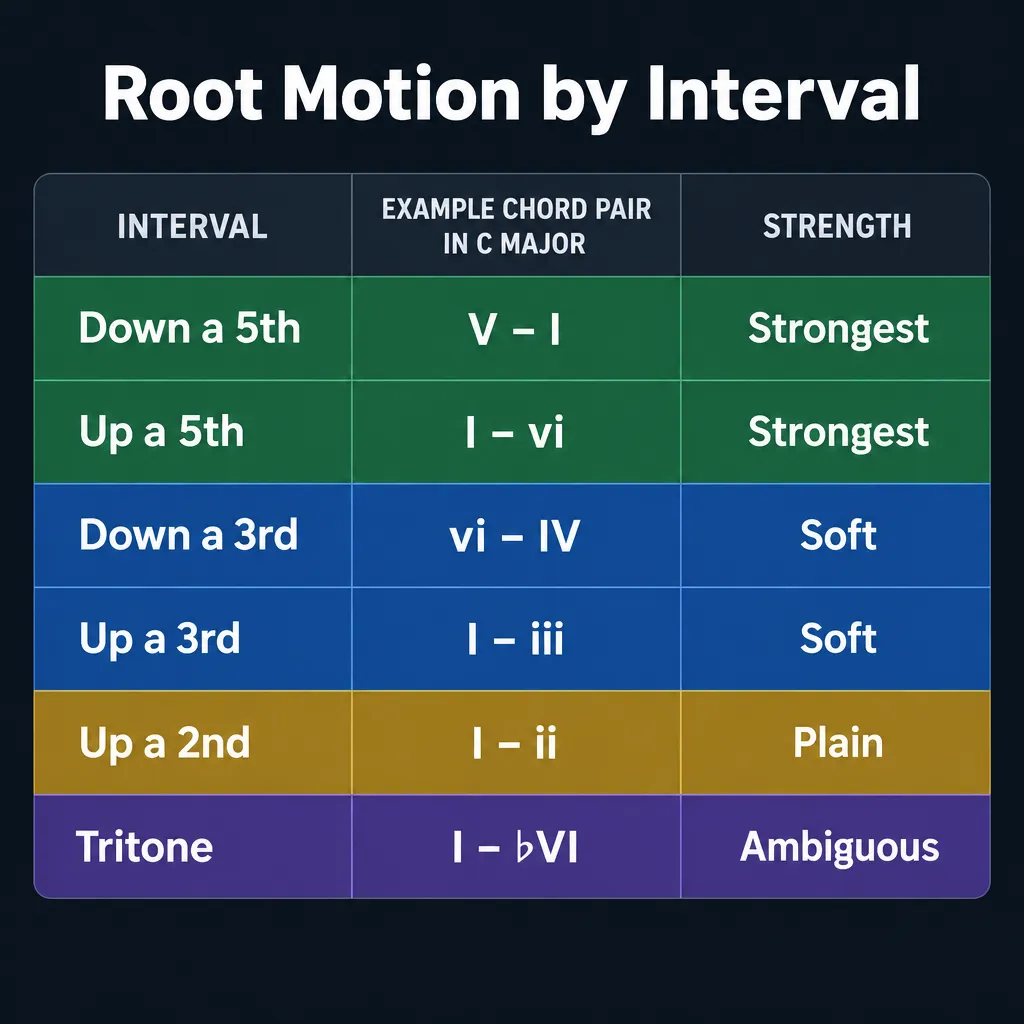
You can describe every root movement as a fifth, a third or a second, because intervals invert. Root motion down a fifth is the same pitch-class move as up a fourth, and up a third is the same as down a sixth. Learnmusictheory.net’s harmonic progression handout uses this equivalence to sort all root motion into those three families. The tritone is the odd one out. It splits the octave exactly in half and points both ways.
| Root motion | Equivalent | Shared tones (triads) | Example in C | Strength / character | Typical use |
|---|---|---|---|---|---|
| Down a 5th | Up a 4th | 1 | V–I (G–C), ii–V (Dm–G) | Strongest, decisive | Cadences, circle-of-fifths chains |
| Up a 5th | Down a 4th | 1 | I–V (C–G), IV–I (F–C) | Strong, but opens rather than closes | Moving away from tonic, plagal cadence |
| Down a 3rd | Up a 6th | 2 | I–vi (C–Am), vi–IV (Am–F) | Soft, gentle colour change | Prolonging a function, pop loops |
| Up a 3rd | Down a 6th | 2 | I–iii (C–Em), vi–I (Am–C) | Soft, slightly weaker | Expressive fills between I and IV |
| Up a 2nd | Down a 7th | 0 | IV–V (F–G), V–vi (G–Am) | Plain, needs care | Climbing into the dominant, deceptive cadence |
| Down a 2nd | Up a 7th | 0 | V–IV (G–F), vi–V (Am–G) | Plain, rock-flavoured | Rock and blues “backdoor” moves |
| Tritone | Tritone | 1 (diatonic) or 2 notes of a 7th chord | IV–vii° (F–B°), Db7–C via sub | Ambiguous, unstable | Tritone substitution, chromatic bass lines |
The open textbook Fundamentals, Function, and Form, published by Milne Open Textbooks at SUNY Geneseo, calls root motion down a fifth or up a fourth the strongest progression in tonal music, especially V to I. The theory site Beyond Music Theory sums up the family character in one line: perfect fifths give strength, thirds are soft, seconds sound tamer, and the tritone creates ambiguity.
Down a fifth / up a fourth: the strongest move
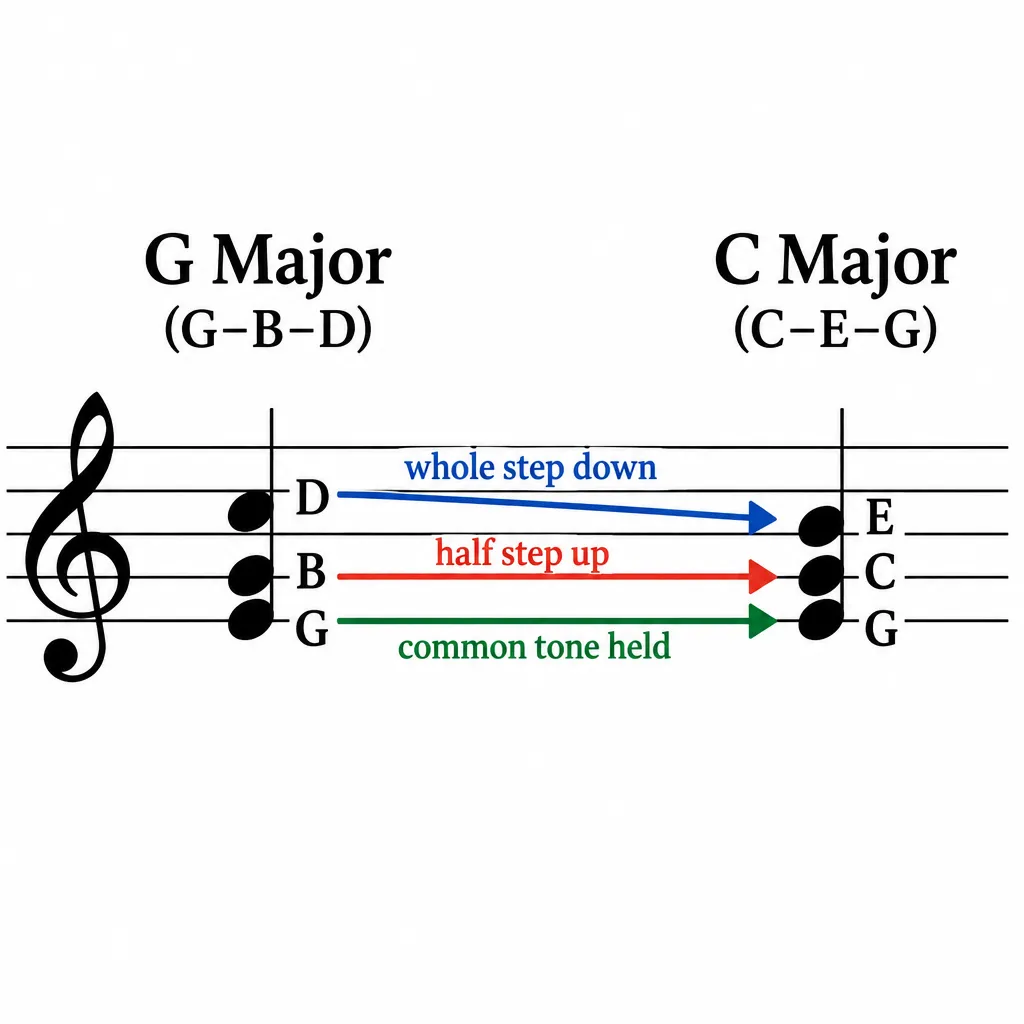
Falling fifths are strong because two things happen at once. One note carries over (G is in both G major and C major), so the ear hears a link. The other notes then resolve by step into stable positions. In G to C, B rises a half step to C, and D falls a whole step to C or rises to E. The new root is also the fundamental that the old chord’s root implies. Your ear hears the C chord as the place the G chord was pointing to.
String falling fifths together and you get the circle of fifths: Am–Dm–G–C, or in jazz Em7–Am7–Dm7–G7–Cmaj7. Each chord sets up the next one.
Theory tip
To make a progression feel like it is going somewhere, approach your target chord from a fifth above it. If you want a softer arrival, come in from a third away.
By thirds: soft, two shared tones
Chords a third apart share two of their three notes. C major (C–E–G) and A minor (A–C–E) share C and E, so only one voice changes, from G to A. Native Instruments’ voice-leading guide gives this as the reason third relations sound smooth. The downside is weak forward motion. C to Am is more a change of colour than a change of direction, which is why I–vi usually sits inside a progression and rarely ends one.
By seconds: stepwise, no shared tones
Chords a step apart share nothing. C to Dm or F to G forces every voice to move, which makes it easy to write parallel fifths or an awkward jump. Fundamentals, Function, and Form notes that sequences moving by seconds or thirds run a greater risk of parallel fifths and octaves than sequences moving by fifths. Stepwise root motion is still everywhere. IV–V is the standard way into a dominant, and V–vi is the deceptive cadence. It just needs the contrary-motion technique covered further down.
The tritone: ambiguous, and why tritone subs work
A tritone root move (F to B, or G to Db) is the same distance up or down, so it doesn’t lean either way. Jazz players use it for exactly that reason. G7 contains the tritone B–F. Db7 contains the same two notes, with Cb spelled as B. Swap Dm7–G7–Cmaj7 for Dm7–Db7–Cmaj7 and the tension notes stay the same, but the bass now slides down by half steps from D to Db to C. That is tritone substitution: the function stays the same and the bass line gets smoother.
Why some movements pull harder: function and the leading tone
Chords pull toward each other because they belong to functional groups. Tonic chords feel at rest, predominant chords move away, and dominant chords demand resolution. Most tonal progressions follow the path tonic, predominant, dominant, tonic (T–PD–D–T). That cycle makes a progression feel like it is “going somewhere” rather than just repeating. Roman numeral analysis is the shorthand for all of this: the numeral names the scale degree of the root, and upper or lower case shows major or minor.
| Function | Chords (Roman) | In C major | Tends to move to |
|---|---|---|---|
| Tonic (T) | I, vi, iii | C, Am, Em | Any chord, most often a predominant |
| Predominant (PD) | ii, IV | Dm, F | V or vii° |
| Dominant (D) | V, vii° | G (or G7), B° | I, or vi in a deceptive cadence |
The music theory site Master the Score groups the chords this way and points out that you can insert iii into I–IV–V (I–iii–IV–V) to make it more expressive. Since iii is a tonic-family chord, adding it stretches the rest before the motion starts without changing the overall direction.
It all comes down to the leading tone. In C major, B sits a half step below C and pulls up into it. The V chord (G–B–D) contains B. Add the seventh (F) and you get the tritone B–F, which resolves inward to C–E. B diminished (B–D–F) contains both the leading tone and that tritone, so vii° does the same job as V even without the G root. That is why it sits in the dominant group.
Did you know?
In a Markov-chain analysis of Hooktheory’s TheoryTab song database, G (the V chord) was the most common chord to follow C (the I chord), coming next 31% of the time.
The harmonic flowchart in plain English
- Start on a tonic chord (I, or vi for a darker start).
- Move to a predominant (ii or IV). You can pass through iii or vi on the way.
- Move to a dominant (V or vii°). This is where the tension peaks.
- Resolve to I for closure, or to vi to dodge it and keep going.
Some progressions feel like they arrive and others feel like they circle forever, and the flowchart explains why. Loops like vi–IV–I–V never land a clear V–I at the end of a phrase, so the cycle feels continuous. Progressions that run PD–D–T end with a resolution your ear accepts as an arrival.
Cadences: where movement lands
A cadence is the chord movement that ends a phrase. There are four main types:
- Authentic (V–I): the strongest close, a falling fifth with the leading tone resolving.
- Plagal (IV–I): the “amen” ending. It is softer and uses a rising fifth.
- Half (ends on V): a comma, not a full stop. The phrase pauses on tension.
- Deceptive (V–vi): the dominant resolves up a step to vi instead of I. It sounds like a surprise and keeps the song going.
Voice leading: making chords move smoothly
Voice leading is how each note in a chord moves to a note in the next chord. Berklee Online gives three working rules. Keep common tones in the same voice. Move the remaining voices by step where possible. Don’t move any single voice more than a third. Follow those and nearly any progression will sound connected, long before you reach extended chords.
Common-tone movement
The C to F example from Skoove’s voice-leading lesson shows the idea. C major is C–E–G and F major is F–A–C. Hold C where it is, then move E up a half step to F and G up a whole step to A. Two fingers move, each by one step, and the chord changes without a jump.
C to Am is even simpler. Keep C and E and move G up to A. One voice changes.
Producer tip
When two chords share notes, keep those notes in the same voice and move only the ones that have to change. On piano that usually means a different inversion, not a new hand position. In a piano roll, it means dragging one or two notes instead of the whole block.
Contrary motion when chords share nothing
When the roots are a step apart, move the upper voices in the opposite direction to the bass. For IV to V in C, the bass goes up from F to G. Above it, take C down to B, A down to G and F down to D. Every voice moves by step or a small skip, the leading tone B appears, and nothing moves in parallel with the bass.
That matters because of parallel fifths. If two voices sit a perfect fifth apart (say F and C) and both move up a step to keep a fifth (G and D), the two lines merge into one hollow sound and the texture loses independence. Classical part-writing rules ban it. Pop and rock use parallel fifths on purpose in power chords. In a pad or string part, though, they make the harmony sound thin, and contrary motion fixes it easily.
Voice-leading checklist by root motion
| Root motion | Shared tones | What to hold | What to move | Main risk |
|---|---|---|---|---|
| Fifth (G–C) | 1 | The shared note (G) | Leading tone up, others by step | Leaving the leading tone unresolved |
| Third (C–Am) | 2 | Both shared notes (C, E) | One voice by step (G to A) | Little forward motion |
| Second (F–G) | 0 | Nothing | Upper voices against the bass | Parallel fifths and octaves |
| Tritone sub (Db7–C) | 2 in 7th chords | The tritone pair, resolved inward | Bass by half step | Muddy low voicings |
7 common chord progressions and how their chords move
These seven progressions cover most of what you hear in pop, rock, jazz and film music. An academic report analysing about 10,000 songs from Hooktheory’s TheoryTab data found C–G–Am–F (I–V–vi–IV) and C–F–G–C (I–IV–V–I) to be the two most frequent progressions. Its top three-chord sequences included F–C–G, C–F–C and F–G–C.
| Progression | In C | Root motions | Feel | Listen for |
|---|---|---|---|---|
| I–IV–V–I | C–F–G–C | Up 4th, up 2nd, down 5th | Direct, folk and rock | The full T–PD–D–T path |
| I–V–vi–IV | C–G–Am–F | Up 5th, up 2nd, down 3rd | Anthemic pop | No V–I, so it loops |
| I–vi–IV–V | C–Am–F–G | Down 3rd, down 3rd, up 2nd | 1950s doo-wop | Soft thirds, then a push |
| ii–V–I | Dm–G–C | Down 5th, down 5th | Jazz resolution | Two falling fifths in a row |
| vi–ii–V–I | Am–Dm–G–C | Down 5th ×3 | Turnaround | A full circle-of-fifths chain |
| I–iii–IV–V | C–Em–F–G | Up 3rd, up 2nd, up 2nd | Rising, expressive | A steadily climbing bass |
| i–VI–III–VII | Am–F–C–G | Down 3rd, up 5th, up 5th | Epic minor | Minor tonic, no leading tone |
Popular progressions often don’t seem to match textbook examples, and the usual reason is rotation. Am–F–C–G uses the same four chords as C–G–Am–F. Whether you analyse it as i–VI–III–VII in A minor or vi–IV–I–V in C depends on which chord feels like home. The melody, the bass emphasis and where the phrase ends decide that. The chord list doesn’t.
The famous 4-chord progression (I–V–vi–IV)
The famous four-chord progression is I–V–vi–IV. The Australian comedy group Axis of Awesome built its “4 Chords” medley on it, singing a string of hits over the same loop. The band changed the song list over the years, so published counts run from 36 to 47 songs depending on the version. The 38-song performance is the one most often cited. “Let It Be” by the Beatles (C–G–Am–F) and “Don’t Stop Believin’” by Journey (E–B–C♯m–A) both use the progression. It works because every move is mild: up a fifth, up a step, then down a third, with plenty of shared notes and no hard landing to break the loop.
Circle-of-fifths chains
ii–V–I and vi–ii–V–I are falling-fifth chains, and jazz extends them with secondary dominants. A secondary dominant is the V of a chord other than the tonic, such as A7 as the V of Dm. The 1931 standard “All of Me” by Seymour Simons and Gerald Marks is a clear example. Its changes in C run C6–E7–A7–Dm7 and later D7–G7. Every root falls a fifth (E to A to D to G to C), and each dominant seventh points at the next chord. Each dominant seventh brings its own leading tone, so every step pulls harder than plain diatonic chords would.
Minor-key movement
In natural minor, the v chord is minor (Em in A minor) and has no leading tone. Minor-key pop therefore leans on i–VI–III–VII and i–iv–VII–III and lets the bass carry the motion. For a real cadence, borrow the harmonic minor V (E major, with G♯) so the leading tone can pull up into A. A guide to music scales explains why G♯ shows up, covering natural, harmonic and melodic minor.
Adding movement over a chord that won’t change
When a song sits on one chord for two or four bars, you can keep it moving with passing chords and inner lines without changing the function. Jazz guitarists call this adding motion to comping. Producers use the same tricks in pads and keys to stop a loop going stale.
Half-step approach chords
Hit a chord a half step above or below your target for one beat, then resolve. Going to C, play B7 or Db7 on beat four of the bar before. On guitar, slide the same shape one fret. On piano, shift the whole voicing by a semitone. The ear accepts almost any chromatic approach because the resolution is only a half step away.
Inner-voice lines
Hold the root and the outer notes and move one inner voice. Over C, run the top line G–A–B–D (fifth, sixth, major seventh, ninth) for C, C6, Cmaj7, Cadd9. Over A minor, the classic line cliché moves the inner voice down chromatically: Am, Am(maj7), Am7, Am6 (A–G♯–G–F♯). A pedal tone does the reverse. Keep C in the bass while the chords above it change (C, F/C, G/C, C), so the harmony moves but the floor stays put. A walking bass line, with one note per beat linking chord tones by step, adds motion from below.
Altered dominants
Before resolving to I, colour the V chord. Going from G7 to G7♭9 (adding A♭) to C adds a new tension note that falls a half step into G. On piano, keep the left hand on G and B and move the right hand. On guitar, many G7 shapes become G7♭9 when you move one finger. Tritone substitution, covered in the chart above, takes the same idea further.
How to practice chord shifting on guitar
The fastest way to clean up chord changes is to practise the change itself, slowly and without strumming, then add speed in small steps. Muddy changes almost always come from lifting fingers too high, landing them one at a time, or strumming at full song tempo before the shape is automatic.
| Drill | Tempo | Duration | Goal |
|---|---|---|---|
| Air changes | No metronome | 1 minute | Form the next shape in the air and land all fingers at once |
| Perfect changes | Slow, untimed | 2 minutes | Every string rings clean after each change |
| One Minute Changes | Count changes in 60 s | 2 × 1 minute | Speed. Log your score daily |
| Metronome changes | 60 BPM, one change per 4 clicks, then 2, then 1 | 3 minutes | Changes land on the beat |
| Strum plus change | Song tempo or slower | 2 minutes | Keep the strumming hand moving through the change |
Start with an in-tune instrument. A free online guitar tuner takes seconds and stops you blaming your fingers for a pitch problem. Keep a guitar chord chart nearby for any shape you haven’t memorised yet.
The 60-second change drill
JustinGuitar’s One Minute Changes exercise is simple. Pick two chords, set a timer for one minute, and count how many clean changes you make. Stage 1 of his Beginner Course pairs A and D. The lesson sets a target of 30 changes a minute before moving on. Forum moderators say not to count the starting chord, and a full A-to-D-and-back cycle counts as one change. Count every single switch instead and the same target is 60, which is one change per click at 60 BPM. A separate Perfect Chord Changes lesson works on accuracy, so the two lessons together cover both speed and clean changes.
Guitar tip
Drill only the change that trips you up. Use two chords, a metronome at 60 BPM and one change per click, then raise the tempo 4 to 5 BPM at a time once it feels easy.
Anchor fingers and shared shapes
An anchor finger stays on the fretboard through a change. A pivot finger stays on the same string and slides. Both come straight from common tones. C (x32010) to Am (x02210) keeps the index finger on the B string at fret 1, but the D-string note is played by a different finger (ring in Am, middle in C) and the G-string fingering changes too. G to Cadd9 can keep the ring and pinky planted on the top two strings at fret 3. Em to Am is the same shape moved over one string set. Look for these overlaps before you learn a song.
To stop looking at your hand on every change, close your eyes during the air-change drill. You will start to feel the shape as a single grip instead of three separate finger placements.
When to add strumming back
Changes that slow down while strumming gets messier are a sign that two skills are competing for attention. Keep strumming out of it until the change is clean at 60 BPM. Then add a single down-strum on beat one. Then strum all four beats and let the last upstroke before the change hit open strings. That brief open-string moment is normal, and plenty of experienced players use it. If your perfect changes still feel slow, keep them in the routine but move most of your time to One Minute Changes. Untimed accuracy work stops paying off quickly without the time pressure.
Chord movement on piano: inversions that keep your hand still
On piano, smooth chord movement means changing inversions so your right hand barely moves while your left hand plays the roots. This is voice leading applied directly. Shared notes stay under the same fingers, and the other notes step to the nearest chord tone.
Inversion map for I–IV–V–I
| Chord | Left hand | Right hand (low to high) | Inversion |
|---|---|---|---|
| C | C | C–E–G | Root position |
| F | F | C–F–A | Second inversion |
| G | G | B–D–G | First inversion |
| C | C | C–E–G | Root position |
The top voice moves G–A–G–G, the middle E–F–D–E and the bottom C–C–B–C. No finger moves more than two semitones, and the B to C step gives you the leading-tone resolution.
I–V–vi–IV with minimal hand travel
Play C (C–E–G), then G in first inversion (B–D–G), Am in first inversion (C–E–A) and F in second inversion (C–F–A), with the left hand on C, G, A and F. The right hand stays inside a five-note span the whole time. Program this version into a pad or keys track, because it sounds smooth and doesn’t jump register every bar.
Hear and test chord movement with free software
You can test every movement in this guide with three free tools. Hooktheory Trends shows the likely next chord, MuseScore Studio notates the progression and plays it back, and LMMS turns it into a production. All three run on Windows, macOS and Linux.
Quick steps: test a chord movement for free
- Pick a starting chord in Hooktheory Trends and note the most likely next chords.
- In MuseScore Studio, add chord symbols with Ctrl+K (Cmd+K on Mac).
- Turn on chord symbol playback and listen.
- Rebuild the voicing in the LMMS piano roll and adjust single notes.
- Compare a falling-fifth version with a third-based version.
MuseScore Studio is free, open-source notation software under the GPL. Version 4.7.5, released September 8, 2026, is the current stable release. It follows the May 2026 4.7.0 update, which added new engraving tools, guitar features and audio engine upgrades. For voice-leading practice, write out all four voices as notes instead of relying on chord-symbol playback, so you control every inversion from the charts above.
LMMS is a free, open-source DAW under the GPL, and 1.2.2 is the current stable version. Draw each voice into the piano roll by hand and you can apply the voice-leading rules one note at a time. If you are still choosing a main free DAW, LMMS is one of several solid options, and a guide to beats for beginners covers piano-roll basics.
Watch out
Projects saved in the LMMS 1.3.0-alpha.2 preview cannot be reopened in older versions. Keep a backup copy before you open stable-version projects in the alpha.
Hooktheory Trends is free. Click a chord and it shows the chords most likely to come next, based on the TheoryTab database. Use it to check whether a movement is common or unusual before you commit to it. Hooktheory also sells Hookpad and its books, so expect some upselling around the tool. Exploring the Trends data costs nothing.
Did you know?
JustinGuitar’s Beginner Course asks you to reach 30 A-to-D changes in one minute before you move on. That makes One Minute Changes one of the few chord-shifting drills with a fixed, published target.
FAQ
What is chord movement in music?
Chord movement is how one chord leads to the next. You can describe it by root motion (fifth, third, second or tritone), by function (tonic, predominant, dominant) and by voice leading, meaning how each note travels. For players, it also means physically shifting between chord shapes.
What are 7 common chord progressions?
I–IV–V–I, I–V–vi–IV, I–vi–IV–V, ii–V–I, vi–ii–V–I, I–iii–IV–V and the minor-key i–VI–III–VII. In C these are C–F–G–C, C–G–Am–F, C–Am–F–G, Dm–G–C, Am–Dm–G–C, C–Em–F–G and, in A minor, Am–F–C–G.
How to practice chord shifting?
Practise the change by itself, with no strumming. Do air changes, then slow perfect changes, then JustinGuitar’s One Minute Changes, then changes against a metronome at about 60 BPM. Raise the tempo only once every string rings clean, and add strumming back last.
What is the famous 4 chord progression?
I–V–vi–IV, which is C–G–Am–F in C. Axis of Awesome’s “4 Chords” medley made it famous by singing dozens of hit songs over that one loop. The most widely cited version uses 38 songs.
What is the forbidden chord on guitar?
There is no single forbidden chord. The phrase usually refers to the tritone, an interval of three whole steps nicknamed “diabolus in musica” or the devil’s interval, which older theory treated as a dissonance to avoid. A tritone is two notes, not a chord, but it sits inside common chords: B–F in G7 and in B diminished. The “forbidden riff” is a separate thing, a guitar-shop joke about overplayed intros such as “Stairway to Heaven”.
Which chord movement is the strongest?
Root motion down a fifth (or up a fourth), especially V to I. One note is shared, the leading tone rises a half step into the tonic, and the other voices resolve by step.
What is harmonic rhythm?
Harmonic rhythm is how often the chords change, for example one chord per bar or two per bar. Speeding it up toward the end of a phrase builds momentum into the cadence.
How do I make chord progressions sound smooth?
Hold common tones in the same voice, move the other voices by step, and don’t leap more than a third in any voice. When chords share no notes, as in IV to V, move the upper voices against the direction of the bass. Chord inversions are how you do this on keys.
What is a chord progression formula?
A chord progression formula is a progression written in Roman numerals, such as ii–V–I, so it works in any key. The numerals give the scale degree of each root, and upper or lower case shows major or minor.
How do I change chords faster on guitar?
Use anchor fingers that stay down between shapes. Land all fingers at once rather than one by one, and keep them close to the fretboard. Drill the one change that slows you down for a couple of minutes every day and log your One Minute Changes score against JustinGuitar’s target of 30.
Your next step
Pick a progression you already use and find the change that sounds flat. Rewrite it with one falling fifth or one held common tone, then play both versions back in MuseScore Studio or LMMS. Hearing the two side by side is the quickest way to learn what each root motion does.
Keep reading
Free music tools
Editorial notes
- Fact-checked by Vivian Osei against the sources listed below before publication.
- Published
Sources (8)
- Fundamentals, Function, and Form: root motion and harmonic progression (milnepublishing.geneseo.edu)
- Fundamentals, Function, and Form: Other Diatonic Sequences (milnepublishing.geneseo.edu)
- learnmusictheory.net: Harmonic Progression (learnmusictheory.net)
- Beyond Music Theory: Harmonic Movement and Chord Progressions (beyondmusictheory.org)
- Hooktheory blog: chord progression analysis (hooktheory.com)
- Chord Progression Analysis Report (Hooktheory data) (salu133445.github.io)
- Hooktheory Trends tool (hooktheory.com)
- Berklee Online: Voice Leading Paradigms (online.berklee.edu)